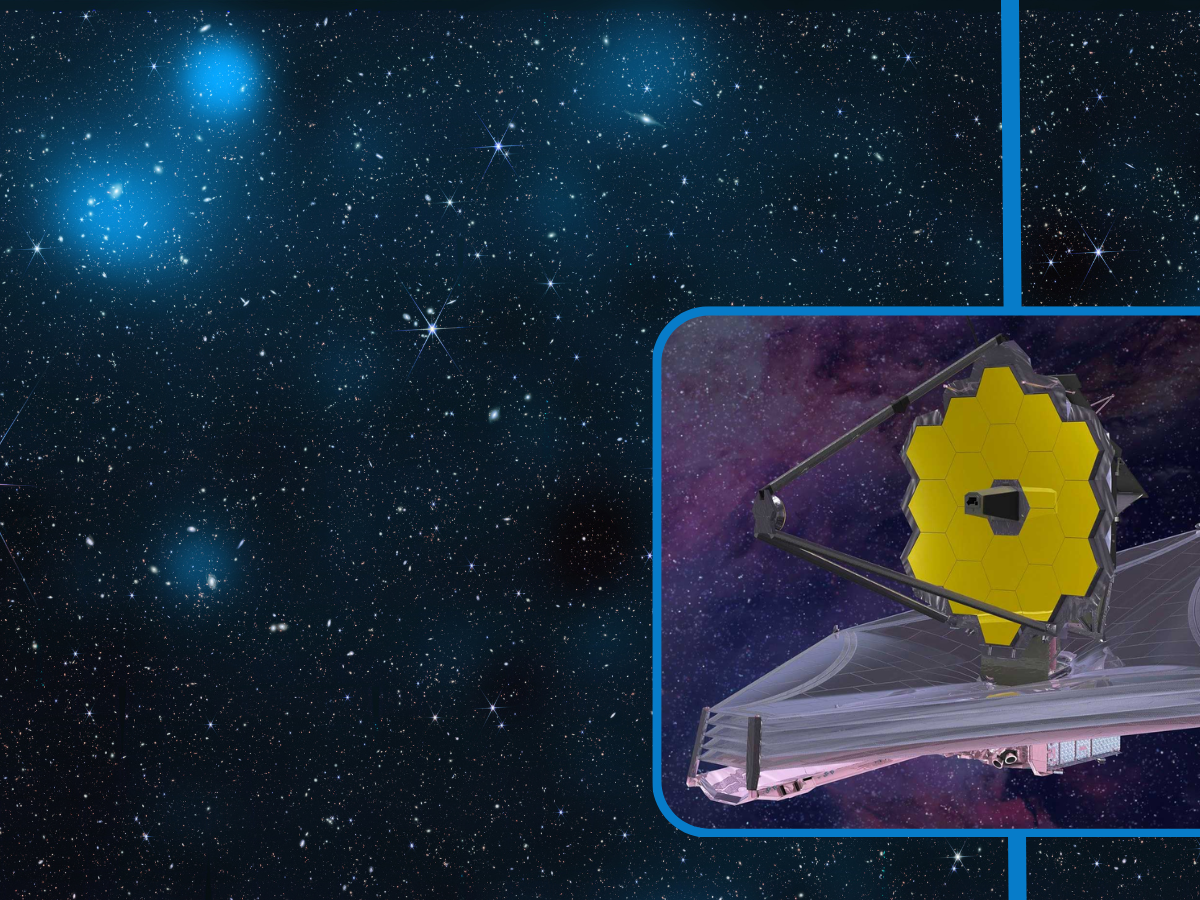
The James Webb Space Telescope, launched in December 2021, has been making waves in the scientific community with its unprecedented capabilities to study the universe in infrared light. This cutting-edge telescope has been designed to observe the faint light emitted by distant galaxies, stars, and planets, providing insights into the formation and evolution of our universe. The latest discovery, published in a recent study, has taken the scientific community by storm, offering a glimpse into the mysterious realm of dark matter.
Unveiling the Secrets of Dark Matter
Dark matter is a type of matter that does not emit, absorb, or reflect any electromagnetic radiation, making it invisible to our telescopes. Despite its elusive nature, scientists have long suspected its presence, as its gravitational influence can be detected on visible matter. The James Webb Space Telescope has successfully mapped the distribution of dark matter in 800,000 galaxies, providing a detailed picture of this enigmatic force.
The study, led by a team of astronomers from the Space Telescope Science Institute, used the James Webb Space Telescope's advanced spectrograph to analyze the light emitted by distant galaxies. By analyzing the light spectra, the researchers were able to identify the presence of dark matter and map its distribution in the galaxies. This groundbreaking discovery has opened up new avenues for research into the nature of dark matter and its role in the universe.
Implications for Our Understanding of the Universe
The findings of this study have significant implications for our understanding of the universe's structure and evolution. Dark matter is thought to make up approximately 27% of the universe's mass-energy density, while visible matter accounts for only 5%. The remaining 68% is attributed to dark energy, a mysterious force driving the acceleration of the universe's expansion. By studying dark matter, scientists hope to gain a deeper understanding of the universe's evolution and the role of dark energy.
The James Webb Space Telescope's discovery has sparked excitement among scientists, who believe that this achievement marks a significant milestone in our understanding of the universe. As researchers continue to analyze the data, they expect to uncover new insights into the nature of dark matter and its role in shaping the universe as we know it.
Next Steps in Dark Matter Research
With the James Webb Space Telescope's groundbreaking discovery, scientists are now eager to build upon this research and explore new avenues of inquiry. Future studies will focus on refining our understanding of dark matter's properties and behavior, shedding light on its role in the universe's evolution. The James Webb Space Telescope will continue to play a crucial role in this research, providing unprecedented insights into the universe's mysteries.
As scientists continue to unravel the secrets of dark matter, they are also working on developing new technologies to improve our understanding of the universe. The next-generation telescopes, such as the James Webb Space Telescope's successor, the Habitable Exoplanet Imaging Mission (HabEx), will be designed to study the universe in greater detail, pushing the boundaries of our knowledge and understanding.
The discovery of dark matter by the James Webb Space Telescope marks a significant milestone in our understanding of the universe. As researchers continue to explore the mysteries of dark matter, they are uncovering new insights into the nature of the cosmos and the role of this enigmatic force in shaping the universe as we know it.