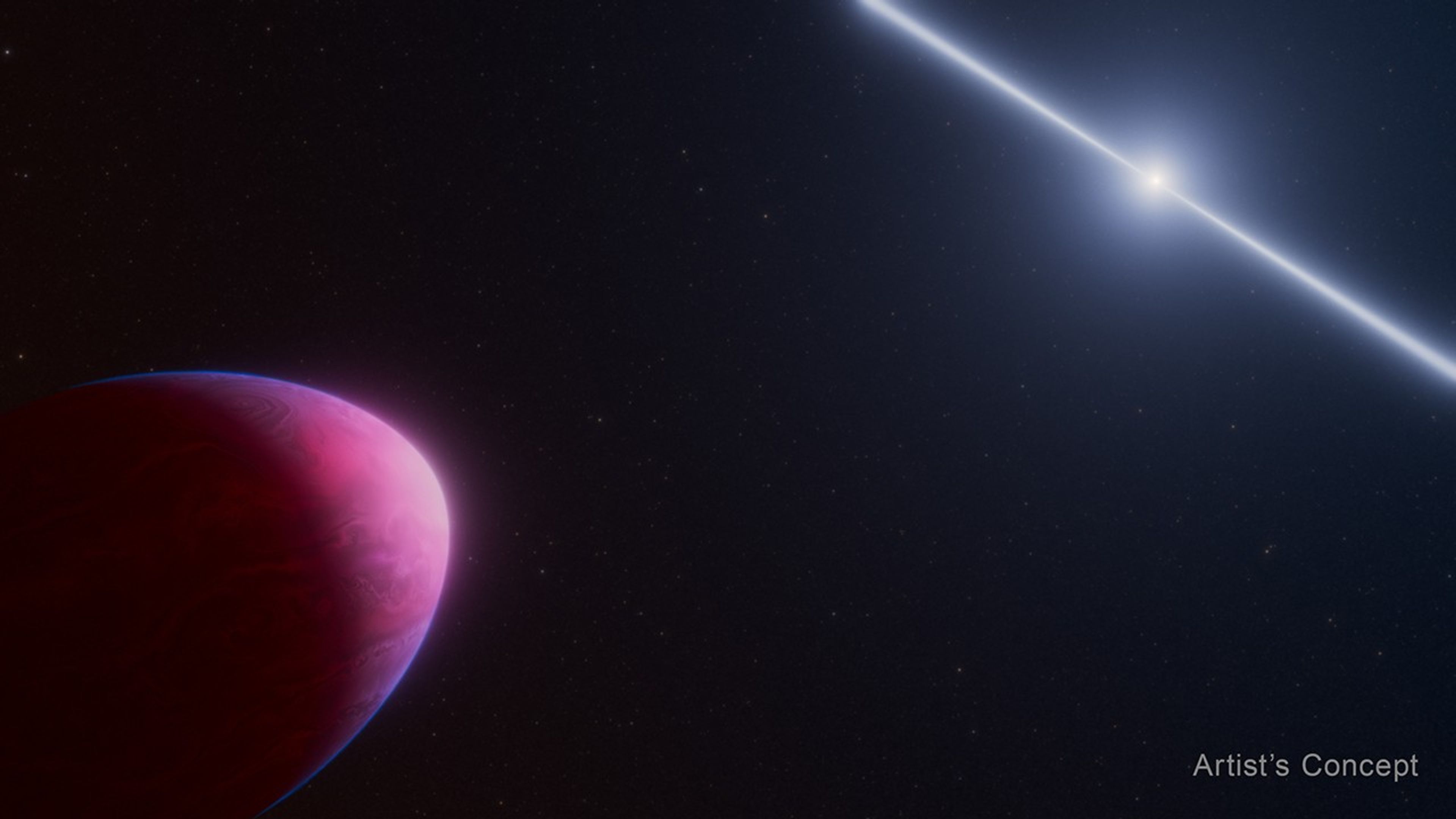
The James Webb Space Telescope (JWST), launched in December 2021, has been making waves in the astronomical community with its cutting-edge observations of distant exoplanets. The latest discovery, announced by NASA's Science Division, has left scientists scratching their heads. The exoplanet in question, designated as K2-18b, has a composition that is unlike anything seen before, with a unique combination of gases that defy explanation.
According to NASA, the JWST's spectrographic analysis of K2-18b's atmosphere revealed the presence of both water vapor and methane, a combination that is not typically found in exoplanet atmospheres. This finding has significant implications for our understanding of planetary formation and evolution, as it challenges the current theories of how gas giants like K2-18b form and evolve over time.
Unraveling the Mystery of K2-18b's Composition
The discovery of K2-18b's unusual composition has sparked a flurry of interest among astronomers and planetary scientists, who are eager to unravel the mystery behind this enigmatic world. To better understand the exoplanet's atmosphere, scientists will need to conduct further analysis using the JWST and other telescopes. This will involve studying the exoplanet's atmospheric properties, such as its temperature, pressure, and chemical composition, to gain a deeper understanding of its internal workings.
One possible explanation for K2-18b's anomalous composition is that it may be a "waterworld," a type of exoplanet that is composed primarily of water. However, this theory is still speculative, and further research is needed to confirm or rule out this possibility. Whatever the explanation, the discovery of K2-18b's unusual composition has significant implications for our understanding of planetary science and the search for life beyond Earth.
The Significance of K2-18b's Discovery
The discovery of K2-18b's unusual composition has significant implications for the search for life beyond Earth. The exoplanet's atmosphere, which is thought to be capable of supporting liquid water, makes it a prime candidate for hosting life. However, the presence of methane, a potent greenhouse gas, raises questions about the exoplanet's habitability and the potential for life to thrive on its surface.
The discovery of K2-18b also highlights the importance of continued research into the properties of exoplanet atmospheres. By studying the atmospheres of distant worlds, scientists can gain a deeper understanding of the conditions necessary for life to emerge and thrive, ultimately informing the search for life beyond our solar system.
The Future of Exoplanet Research
The discovery of K2-18b's unusual composition has opened up new avenues of research in the field of exoplanetary science. As scientists continue to study the exoplanet's atmosphere and internal workings, they may uncover new insights into the formation and evolution of gas giants. This knowledge could, in turn, inform the search for life on other exoplanets, potentially paving the way for future missions to explore the atmospheres of distant worlds.
The discovery of K2-18b also highlights the importance of continued investment in space-based telescopes like the JWST. By pushing the boundaries of what is possible with current technology, scientists can make new discoveries that challenge our understanding of the universe and inspire new areas of research.
As scientists continue to study K2-18b and other exoplanets, we may uncover new secrets about the universe and our place within it. The discovery of K2-18b's unusual composition is a testament to the power of human curiosity and the boundless potential of scientific inquiry.