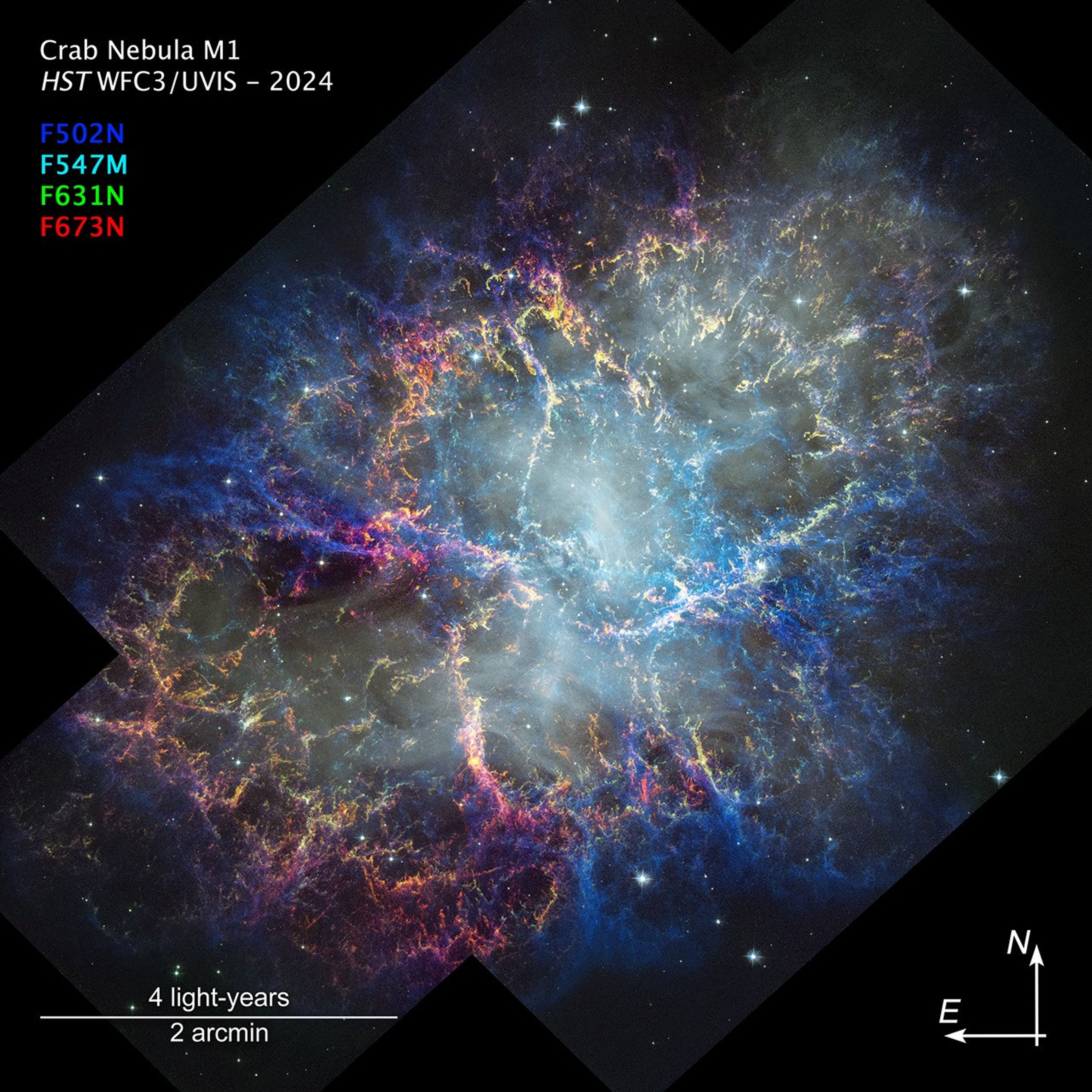
The Crab Nebula, located about 6,500 light-years from Earth in the constellation Taurus, is the remnant of a massive star that exploded in a supernova in 1054 AD. The explosion was so powerful that it was visible to the naked eye from Earth for several months. Since then, the Crab Nebula has been a subject of intense study, with astronomers using various telescopes to observe its evolution over time.
25 Years of Hubble Observations
NASA's Hubble Space Telescope has been monitoring the Crab Nebula for over 25 years, providing a unique opportunity to study its expansion and evolution. The telescope's high-resolution images have revealed intricate details about the nebula's structure and behavior. By analyzing these images, scientists have been able to track the movement of gas and dust within the nebula, gaining insights into the physics of supernovae explosions.
The latest observations made by Hubble have revealed that the Crab Nebula is expanding at a rate of about 1,000 kilometers per second. This is a significant increase from previous estimates, which suggested a rate of around 500 kilometers per second. The acceleration of the nebula's expansion is likely due to the interaction between the explosion's shockwave and the surrounding interstellar medium.
Insights into Supernovae Physics
The study of the Crab Nebula's expansion over the past 25 years has provided scientists with valuable insights into the physics of supernovae explosions. By analyzing the data collected by Hubble, researchers have been able to test theories about the behavior of matter in extreme environments. The findings of this study have significant implications for our understanding of astrophysical phenomena, such as gamma-ray bursts and neutron star mergers.
The Crab Nebula is a remarkable example of the power and beauty of the universe. Its expansion over the past 25 years has provided scientists with a unique opportunity to study the evolution of this celestial wonder. As Hubble continues to observe the Crab Nebula, scientists will gain even more insights into the physics of supernovae explosions and the behavior of matter in extreme environments.
Future Research Directions
Future research directions will focus on continuing to monitor the Crab Nebula's expansion and evolution. By using Hubble and other telescopes, scientists will be able to study the nebula's behavior in even greater detail. This will provide valuable insights into the physics of supernovae explosions and the behavior of matter in extreme environments.
Additionally, scientists will be using Hubble to study other supernovae remnants, such as the Cygnus Loop and the Veil Nebula. These observations will provide a broader understanding of the physics of supernovae explosions and the behavior of matter in extreme environments.
The study of the Crab Nebula's expansion over the past 25 years has been a significant achievement in the field of astrophysics. As Hubble continues to observe this celestial wonder, scientists will gain even more insights into the physics of supernovae explosions and the behavior of matter in extreme environments.
The latest observations made by Hubble have revealed that the Crab Nebula is expanding at a rate of about 1,000 kilometers per second. This is a significant increase from previous estimates, which suggested a rate of around 500 kilometers per second.
By analyzing the data collected by Hubble, researchers have been able to test theories about the behavior of matter in extreme environments. The findings of this study have significant implications for our understanding of astrophysical phenomena, such as gamma-ray bursts and neutron star mergers.
The study of the Crab Nebula's expansion over the past 25 years has provided scientists with a unique opportunity to study the evolution of this celestial wonder. As Hubble continues to observe the Crab Nebula, scientists will gain even more insights into the physics of supernovae explosions and the behavior of matter in extreme environments.
The Crab Nebula is a remarkable example of the power and beauty of the universe. Its expansion over the past 25 years has provided scientists with a unique opportunity to study the evolution of this celestial wonder.
Future research directions will focus on continuing to monitor the Crab Nebula's expansion and evolution. By using Hubble and other telescopes, scientists will be able to study the nebula's behavior in even greater detail.
The study of the Crab Nebula's expansion over the past 25 years has been a significant achievement in the field of astrophysics. As Hubble continues to observe this celestial wonder, scientists will gain even more insights into the physics of supernovae explosions and the behavior of matter in extreme environments.
By analyzing the data collected by Hubble, researchers have been able to test theories about the behavior of matter in extreme environments. The findings of this study have significant implications for our understanding of astrophysical phenomena, such as gamma-ray bursts and neutron star mergers.
The study of the Crab Nebula's expansion over the past 25 years has provided scientists with a unique opportunity to study the evolution of this celestial wonder. As Hubble continues to observe the Crab Nebula, scientists will gain even more insights into the physics of supernovae explosions and the behavior of matter in extreme environments.
The Crab Nebula is a remarkable example of the power and beauty of the universe. Its expansion over the past 25 years has provided scientists with a unique opportunity to study the evolution of this celestial wonder.
By analyzing the data collected by Hubble, researchers have been able to test theories about the behavior of matter in extreme environments. The findings of this study have significant implications for our understanding of astrophysical phenomena, such as gamma-ray bursts and neutron star mergers.
Conclusion
The study of the Crab Nebula's expansion over the past 25 years has been a significant achievement in the field of astrophysics. By analyzing the data collected by Hubble, researchers have been able to test theories about the behavior of matter in extreme environments. The findings of this study have significant implications for our understanding of astrophysical phenomena, such as gamma-ray bursts and neutron star mergers.