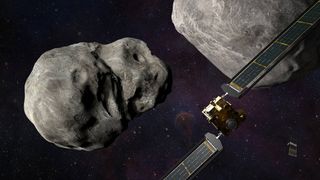
The Double Asteroid Redirection Test (DART) spacecraft, launched by NASA in 2021, has successfully completed its mission to alter the orbit of a small asteroid. On September 26, 2022, the spacecraft collided with Dimorphos, a small asteroid orbiting a larger asteroid called Didymos. The collision was a deliberate attempt to test the effectiveness of asteroid deflection techniques, which could potentially be used to prevent asteroid impacts on Earth.
Key Objectives and Successes
The primary objective of the DART mission was to assess the feasibility of using kinetic impactors to change the trajectory of near-Earth asteroids. The success of this mission has provided valuable insights into the physics of asteroid deflection and has laid the groundwork for future planetary defense strategies. By intentionally crashing into Dimorphos, the DART spacecraft demonstrated the ability to alter the asteroid's orbit around its parent asteroid, Didymos.
The collision had a profound impact on Dimorphos, causing a significant change in its orbital period. Prior to the collision, Dimorphos orbited Didymos in just 11 hours and 55 minutes. However, after the collision, the orbital period increased to 24 hours and 22 minutes. This change in orbital period demonstrates the effectiveness of the DART mission in altering the asteroid's trajectory.
Significance and Future Directions
The success of the DART mission has significant implications for asteroid research and planetary defense. The demonstration of asteroid deflection capabilities has provided a vital tool for mitigating the risk of asteroid impacts on Earth. This technology could potentially be used to prevent catastrophic asteroid collisions and protect life on our planet.
The DART mission has also opened up new avenues for research in asteroid science. The data collected during the mission has provided valuable insights into the composition and structure of asteroids, shedding light on the formation and evolution of our solar system. This knowledge will be crucial for future asteroid exploration and research missions.
Challenges and Limitations
While the DART mission has achieved a groundbreaking success, there are still several challenges and limitations to be addressed. One of the primary concerns is the accuracy and precision required for asteroid deflection. The DART mission demonstrated the ability to alter the asteroid's orbit, but the process was complex and required significant resources. Future missions will need to address these challenges and develop more efficient and effective asteroid deflection techniques.
Another limitation of the DART mission is the scale of the asteroids involved. The Dimorphos asteroid is relatively small, and the collision had a significant impact on its orbit. Future missions may need to address larger asteroids, which would require more powerful and complex deflection techniques.
In conclusion, the DART mission has achieved a historic success in altering the orbit of a small asteroid. The demonstration of asteroid deflection capabilities has provided a vital tool for planetary defense and has opened up new avenues for research in asteroid science. While there are still challenges and limitations to be addressed, the success of this mission marks a significant milestone in space exploration and asteroid research.