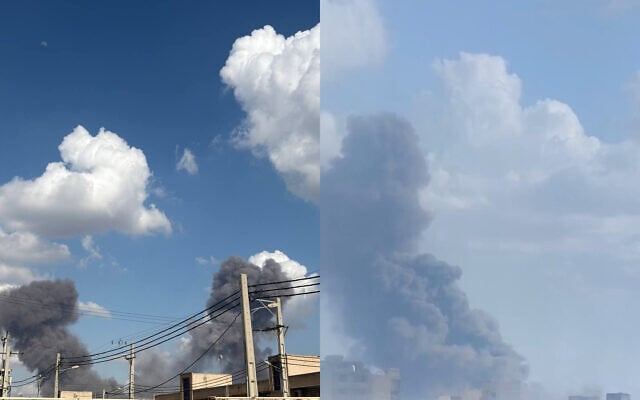
The airstrikes, carried out by Israel's military forces, targeted two steel plants and two nuclear facilities in Iran on Thursday night, according to reports. The steel plants, both linked to Iran's Islamic Revolutionary Guard Corps (IRGC), were reportedly used to produce military-grade equipment, while the nuclear facilities were allegedly involved in Iran's nuclear program.
Escalating Tensions
Israel has long been suspicious of Iran's intentions, particularly with regards to its nuclear program. In recent months, tensions have escalated between the two countries, with Israel warning of the dangers of a nuclear-armed Iran. The airstrikes are seen as a major escalation in Israel's campaign against Iran's nuclear program.
The move has been widely condemned by Iran's allies, including Russia and China, which have called for restraint and a peaceful resolution to the conflict. The international community has also expressed concern over the airstrikes, with the United Nations calling for an emergency meeting to discuss the situation.
Nuclear Program Concerns
Iran's nuclear program has been a major point of contention between the country and the international community for years. Iran has consistently denied any intention to develop nuclear weapons, but concerns have been raised over the country's continued development of its nuclear capabilities.
The steel plants targeted in the airstrikes were allegedly used to produce military-grade equipment, including centrifuges and other components used in the production of nuclear fuel. The nuclear facilities, meanwhile, were reportedly involved in the development of Iran's nuclear program.
The International Atomic Energy Agency (IAEA) has been monitoring Iran's nuclear program for years, but its efforts have been hindered by Iran's refusal to cooperate with inspectors. The IAEA has repeatedly expressed concerns over Iran's nuclear activities, but the country has consistently denied any wrongdoing.
Global Reaction
The airstrikes have sparked a strong reaction from around the world, with many countries condemning the move and calling for restraint. The United States has called for calm, but has also expressed its support for Israel's right to defend itself.
The European Union has called for an emergency meeting to discuss the situation, while the United Nations has issued a statement calling for an end to the violence. Russia and China have also condemned the airstrikes, with Russia calling for a peaceful resolution to the conflict.
As the situation continues to unfold, it remains to be seen how the international community will respond to the airstrikes and what the consequences will be for Israel and Iran.
The airstrikes have raised concerns over the potential for a wider conflict in the region, and have sparked a debate over the role of military force in resolving international conflicts. As the situation continues to evolve, one thing is clear: the stakes are high, and the consequences of the airstrikes will be far-reaching.
The international community will be watching closely as the situation develops, and will be looking for a peaceful resolution to the conflict. But as the airstrikes have shown, the path to peace is often fraught with danger, and the consequences of failure can be catastrophic.
In the end, it will be up to the leaders of Israel and Iran to decide the course of action, but one thing is clear: the world is watching, and the consequences of their decisions will be felt far beyond the borders of these two countries.
As the situation continues to unfold, one thing is certain: the world will be watching, and the consequences of the airstrikes will be felt for years to come.